
What is Artificial Intelligence applied to business? A strategic guide for companies that want to grow through innovation.

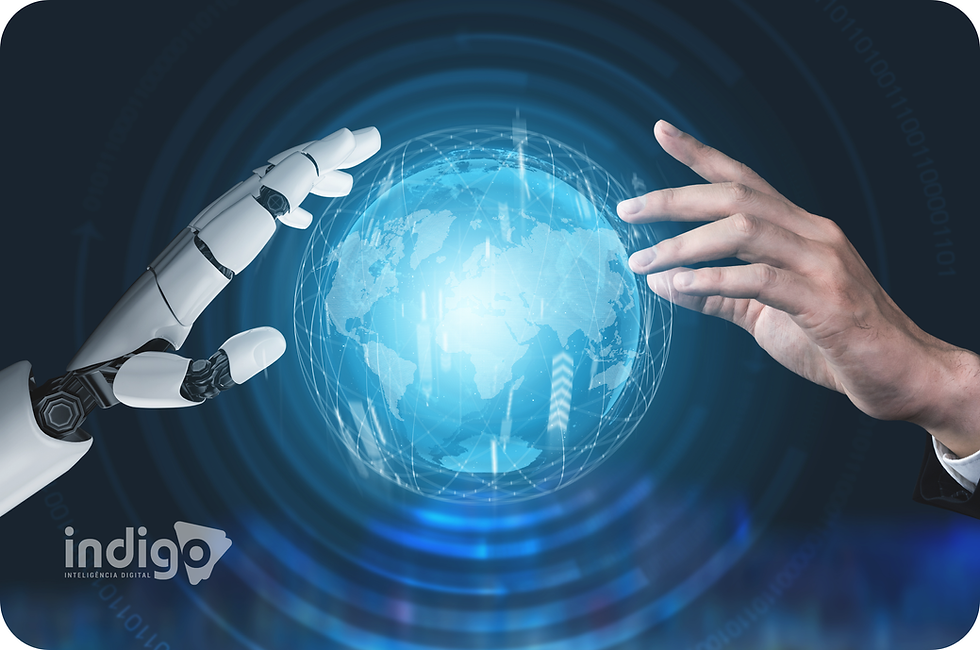
Artificial Intelligence has gone from being the subject of futuristic films to becoming one of the most transformative technologies in business history.
Companies that adopt AI increase productivity, reduce costs, improve decision-making, and create new revenue opportunities.
Companies that ignore it… fall behind.
But here's the essential point:
Many business owners still don't understand, in practice, what Artificial Intelligence applied to business is.
Is it robots?
Is it automation?
Is it a replacement for people?
Is it an expensive tool?
Is it something only for large companies?
In this guide you will understand:
What is Artificial Intelligence?
How it works in a business context
The difference between automation and AI
Practical applications in different sectors
How to implement AI strategically
How to transform AI into a competitive advantage

What is Artificial Intelligence?
Artificial Intelligence is a set of technologies that allows systems to perform tasks that would normally require human intelligence.
These tasks include:
Analyzing data
Recognizing patterns
Learning from information
Making probability-based decisions
Processing natural language
Identifying images
Unlike traditional systems, AI learns from data and improves over time.
AI is not just automation.
It's common to confuse automation with AI.
Automation: Executes repetitive tasks with predefined rules.
AI: Learns patterns and makes data-driven decisions.
Example:
Automation: Sending an automatic email after registration.
AI: Analyzing customer behavior and predicting which offer has the highest chance of conversion.
This difference is strategic.
Main Types of AI Used in Business
1️⃣ Machine Learning
Allows systems to learn from historical data and make predictions.
Applications:
Sales forecasting
Risk analysis
Customer segmentation
2️⃣ Natural Language Processing (NLP)
Allows machines to understand and respond to human language.
Applications:
Chatbots
Sentiment analysis
Virtual assistants
3️⃣ Computer Vision
Interpretation of images and videos.
Applications:
Quality control
Security
Facial recognition
Where AI is already being applied in companies
Marketing
Campaign personalization
Intelligent segmentation
Behavior prediction
Ad optimization
Sales
Intelligent lead scoring
Churn prediction
Opportunity analysis
Finance
Fraud detection
Cash flow forecastin
Credit analysis
Operations
Logistics optimization
Demand forecasting
Predictive maintenance

Strategic Benefits of AI in Business
1️⃣ Data-Driven Decisions
Reduction of intuitive decisions.
2️⃣ Scalability
AI allows for growth without proportional team growth.
3️⃣ Cost Reduction
Less rework, less waste, more accuracy.
4️⃣ Personalized Customer Experience
Customers expect personalization.
AI makes this feasible at scale.
Is AI accessible to medium-sized businesses?
Yes. Today there are:
SaaS platforms with built-in AI
Accessible tools
Ready-to-integrate APIs
The barrier to entry is much lower than it was 5 years ago.

Main Myths About AI
❌ “AI will replace all professionals”
AI replaces repetitive tasks, not strategic thinking.
Professionals who learn to use AI become more productive.
❌ “It’s too expensive”
Expensive means losing competitiveness.
❌ “It’s only for multinational companies”
Small businesses already use AI in marketing, customer service, and management.
How to Implement AI in Your Company
1️⃣ Define a Clear Objective
AI shouldn't be implemented just because it's trendy.
Correct Question:
What strategic problem do I want to solve?
2️⃣ Assess data maturity
AI depends on organized data.
Without structured data, there is no effective learning.
3️⃣ Choose the right solution
Off-the-shelf tool?
Custom development?
Integration with current system?
4️⃣ Train the team
Adoption is as important as technology.
5️⃣ Monitor results
AI needs continuous monitoring.

AI as a competitive differentiator
Companies that use AI:
Make faster decisions
Anticipate trends
Reduce errors
Increase conversion rates
Deliver a superior experience
This generates an innovative positioning.
The future of business is driven by AI.
We are entering a phase where:
Data is the main asset.
Decisions based on advanced analytics will be standard.
Personalization will be mandatory.
Intelligent operations will be a differentiator.
Companies that do not evolve will lose competitiveness.

Conclusion
Artificial Intelligence applied to business is not a luxury.
It is a strategic tool for:
Sustainable growth
Operational efficiency
Continuous innovation
Competitive advantage
The question isn't whether your company should use AI.
The question is:
When will you start using it strategically?


Comments