
Virtual reality and artificial intelligence: how these technologies are shaping the future of business.

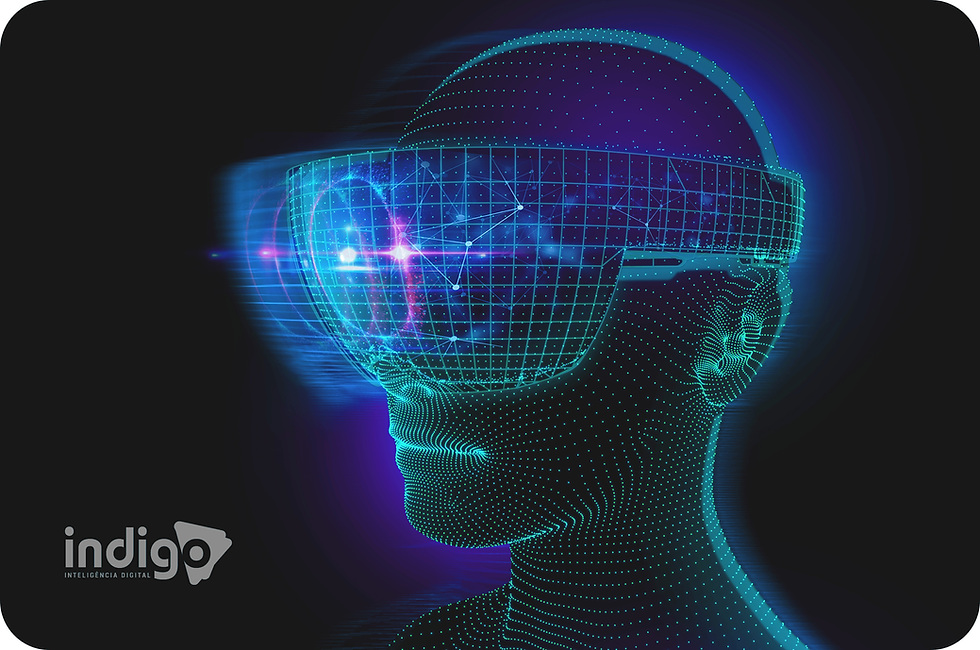
The future is no longer a prediction.
For decades, films, books, and series have imagined a future where people interact with intelligent virtual environments, machines make complex decisions, and digital experiences are virtually indistinguishable from reality.
For a long time, these ideas seemed distant.
Today, they are becoming a reality.
Two technologies play a central role in this transformation:
Virtual Reality (VR)
Artificial Intelligence (AI)
Separately, both have already revolutionized various sectors.
When combined, they create even more impressive possibilities.
Companies in different segments are using these technologies to:
Train teams
Improve customer experiences
Simulate complex scenarios
Automate decisions
Increase productivity
Create new business models
More than technological trends, VR and AI are becoming strategic tools for organizations that want to compete in an increasingly digital market.
The question is no longer whether these technologies will have an impact on business.
The question is how fast this transformation will occur.
What is Virtual Reality?
Virtual Reality is a technology that creates immersive digital environments in which the user can interact as if they were physically present.
Using specific devices, such as virtual reality glasses and motion sensors, it is possible to explore highly realistic three-dimensional environments.
Unlike a traditional screen, VR places the user inside the experience.
This creates an extremely powerful sense of presence.
Currently, the technology is already used in areas such as:
Education
Healthcare
Architecture
Engineering
Industry
Corporate training
Entertainment
Its potential continues to grow as equipment becomes more accessible.
What is Artificial Intelligence?
Artificial Intelligence consists of the ability of computer systems to perform tasks that would normally require human intelligence.
This includes activities such as:
Pattern recognition
Data analysis
Natural language processing
Machine learning
Assisted decision making
In recent years, AI has advanced rapidly due to the combination of three factors:
Increased computing power
Availability of large volumes of data
Evolution of algorithms
Today, AI is present in many solutions used daily, often without us even realizing it.
Why is the combination of VR and AI so powerful?
Virtual Reality creates immersive environments.
Artificial Intelligence makes these environments intelligent.
When these two technologies work together, experiences emerge that are capable of learning, adapting, and responding to user behavior in real time.
Instead of static environments, we have dynamic experiences.
This significantly expands the possibilities for business applications.

The emergence of intelligent digital environments
Imagine a corporate training session in virtual reality.
Without AI, the scenario follows a pre-programmed script.
With AI, the environment can:
Adapt challenges to user performance
Simulate different human behaviors
Provide personalized feedback
Identify areas for improvement
The result is a much more efficient and realistic experience.
Corporate Training in a New Dimension
One of the most promising applications of this combination is in professional development.
Traditional training faces challenges such as:
Low engagement
Difficulty in retention
Practical limitations
High costs
The union between VR and AI allows for the creation of highly realistic scenarios.
Employees can practice complex activities in safe and controlled environments.
Furthermore, Artificial Intelligence can monitor individual performance and personalize the learning experience.
Smarter Business Simulations
Companies often need to make decisions involving high risks.
For example:
Operational expansion
Logistical changes
Crisis management
Strategic planning
Virtual environments combined with AI allow testing different scenarios before real implementation.
This reduces risks and improves the quality of decisions.
More Immersive Customer Service
Customer experience is becoming one of the main competitive differentiators in the market.
In this context, VR and AI offer new possibilities.
Imagine a virtual showroom where the customer can:
Explore products in 3D
Interact with digital environments
Receive personalized guidance from intelligent assistants
This combination creates more engaging and informative experiences.
The Advancement of Digital Twins
One of the most important concepts in modern digital transformation is the Digital Twin.
It is a virtual representation of a physical asset.
It can be:
A machine
A factory
A building
A production line
Virtual Reality allows you to visualize this environment in an immersive way.
Artificial Intelligence analyzes the generated data and identifies relevant patterns.
Together, these technologies help companies monitor operations and anticipate problems.
Virtual Reality and AI in Industry
Industry is one of the sectors most impacted by this technological convergence.
Applications include:
Predictive Maintenance
AI identifies signs of failure before they occur.
Technical Training
Professionals practice procedures in simulated environments.
Operational Planning
Scenarios are tested virtually before implementation.
Occupational Safety
Risk situations can be simulated without real exposure.
These initiatives reduce costs and increase efficiency.
Personalized Corporate Education
The way people learn is changing.
Standardized training doesn't always meet individual needs.
With AI, systems can identify:
Specific difficulties
Learning pace
Areas requiring reinforcement
When this is integrated into immersive environments, the educational experience becomes significantly more effective.

The Role of Game Engines in This Transformation
Much of this experience is built using modern game engines.
Technologies like Unreal Engine and Unity allow for the creation of highly realistic and interactive three-dimensional environments.
These platforms are no longer exclusive to the gaming industry.
Today they are used in:
Business simulations
Training
Project visualization
Immersive customer experiences
They represent the technological infrastructure behind many innovative solutions.
The Impact on Decision Making
One of the greatest advantages of Artificial Intelligence lies in its ability to transform data into insights.
When this information is presented in immersive visual environments, understanding becomes more intuitive.
Managers can visualize complex scenarios with greater clarity.
This leads to faster and better-informed decisions.
Small and medium-sized enterprises can also benefit.
There is a misconception that these technologies are exclusive to large corporations.
Although more sophisticated projects require significant investments, many applications are already accessible to smaller organizations.
Technological advancements have reduced costs and expanded possibilities.
Today it is possible to start projects gradually, focusing on specific business challenges.
The Challenges of Adoption
Like all innovation, the implementation of these technologies requires planning.
Among the main challenges are:
Team training
Integration with existing processes
Definition of clear objectives
Organizational change management
The technology must be aligned with the real needs of the business.
The focus should not only be on innovation.
It should be on value creation.

The future of business will be smarter and more immersive.
In the coming years, we will see increasing integration between:
Artificial Intelligence
Virtual Reality
Augmented Reality
Internet of Things (IoT)
Cloud Computing
Advanced Data Analytics
These technologies will not operate in isolation.
They will form digital ecosystems capable of profoundly transforming how companies operate, train people, serve customers, and make decisions.
The Competitive Advantage of the Next Decade
Throughout history, companies have gained a competitive advantage for different reasons:
Scale
Capital
Location
Technology
In the next decade, the ability to create intelligent and immersive experiences may become one of the main differentiators.
Organizations that begin exploring these possibilities now will be better positioned to seize future opportunities.
Conclusion
The combination of Virtual Reality and Artificial Intelligence is redefining the concept of digital transformation.
These technologies allow for the creation of smarter, more interactive, and efficient experiences, impacting areas such as training, operations, customer service, and decision-making.
More than just technological trends, they represent new ways to solve problems, generate value, and build competitive advantage.
The future of business will not be just digital.
It will be intelligent, connected, and immersive.
Indigo ID keeps up with the technologies that are shaping the next generation of business solutions.
Through the development of systems, digital experiences, immersive environments, and innovative projects, we help organizations transform technology into concrete results.
Because the future of business will not be built only with more technology, but with technology capable of creating smarter, more human, and more efficient experiences.


Comments