
Does AI replace professionals? The real impact of Artificial Intelligence on the job market and business.

"Will Artificial Intelligence eliminate jobs?"
This is one of the most frequently asked questions when it comes to Artificial Intelligence.
Business owners are asking themselves:
Is it worth investing in AI?
Will I need to reduce staff?
How do I prepare my team?
Am I behind schedule in this transformation?
Professionals are asking themselves:
Is my profession threatened?
What should I learn?
How can I stay relevant?
The truth is that AI isn't just replacing jobs—it's redefining the concept of work.
In this article you will understand:
What is really changing?
Which functions are being transformed?
What new opportunities are emerging?
How should companies position themselves?
How leaders should prepare their teams.
How to transform AI into a strategic ally
What does "replacing professionals" mean?
It is important to separate three concepts:
1️⃣ Task substitution
2️⃣ Function Transformation
3️⃣ Creation of new jobs
Most headlines oversimplify the debate.
AI doesn't easily replace entire "professions".
It replaces repetitive, predictable, and pattern-based tasks.
What does AI do better than humans?
AI is superior in:
Massive data processing
Identifying complex patterns
Repetitive execution without error.
24/7 availability
Analysis speed
Example:
Analyze 10,000 contracts to identify specific clauses.
It would take a human weeks.
An AI-powered system takes minutes.
What do humans still do best?
Strategic thinking
Contextual decision making
Complex creativity
Negotiation
Empathy
People management
Leadership
AI is a tool.
Humans are the drivers.

Professions that are being transformed
Customer service
Part of the operational process is being automated.
Professionals are migrating to relationship management and complex cases.
Marketing
AI performs segmentation, data analysis, and personalization.
Professionals are increasingly focusing on strategy and positioning.
Financial
Repetitive analyses are automated.
Analysts are increasingly focused on strategic interpretation.
Legal
Mass document reading is automated.
Lawyers focus on strategy, argumentation, and negotiation.
Professions that are growing with AI
Data experts
BI Analysts
Prompt engineers
Automation experts
Innovation managers
Digital transformation consultants
Furthermore, virtually every field now requires digital skills.
The mistake companies make: focusing only on cost reduction.
Many companies evaluate AI solely from the perspective of:
"How many people can I replace?"
This view is limited.
More mature companies are asking:
"How can I increase productivity, generate revenue, and scale operations?"
Using AI solely for cost-cutting purposes generates short-term gains.
AI used for strategy generates a competitive advantage.
The true impact of AI on businesses
1️⃣ Increased individual productivity
A professional using AI can produce 2x or 3x more.
2️⃣ Reducing rework
Less human error.
More precision.
3️⃣ Faster decision-making
Less reliance on manual reports.
4️⃣ New business models
AI makes it possible to create products and services that were previously unfeasible.
The real risk is not AI.
The real risk is:
Professionals who don't learn how to use AI.
Technology widens the performance gap.
Who uses AI:
Produces more
Analyze it better
Decide with more data.
Delivers more value.
Who doesn't use it:
It gets slower.
It loses competitiveness.
It becomes less strategic.

How leaders should prepare their teams.
1️⃣ Continuing education
Training on:
Fundamentals of AI
Practical use of tools
Data interpretation
2️⃣ Culture of experimentation
Allow controlled testing.
Encourage learning.
3️⃣ Reskilling
Redirecting talent to more strategic roles.
4️⃣ Transparency
Fear stems from a lack of information.
Leaders must explain how AI will be used.
AI and ethics in the corporate environment
Important questions:
Algorithmic bias
Responsible use of data
Transparency in automated decisions
Privacy
AI should be governed by clear policies.
Are small and medium-sized enterprises also impacted?
Yes.
Small businesses have an advantage because:
They can be more agile.
They implement faster.
They have less bureaucracy.
SMEs that adopt AI early can compete with larger companies.
The new professional profile
The professional of the future:
Uses AI as a daily tool.
Analyzes data with critical thinking.
Continuous learning
Acts strategically
Integrates technology into the business.
He is an adaptable professional.
Will AI replace professionals?
Strategic response:
AI replaces repetitive tasks.
Transform functions.
It increases productivity.
It creates new opportunities.
Companies that see AI as a threat tend to fall behind.
Companies that see it as a tool for evolution grow.
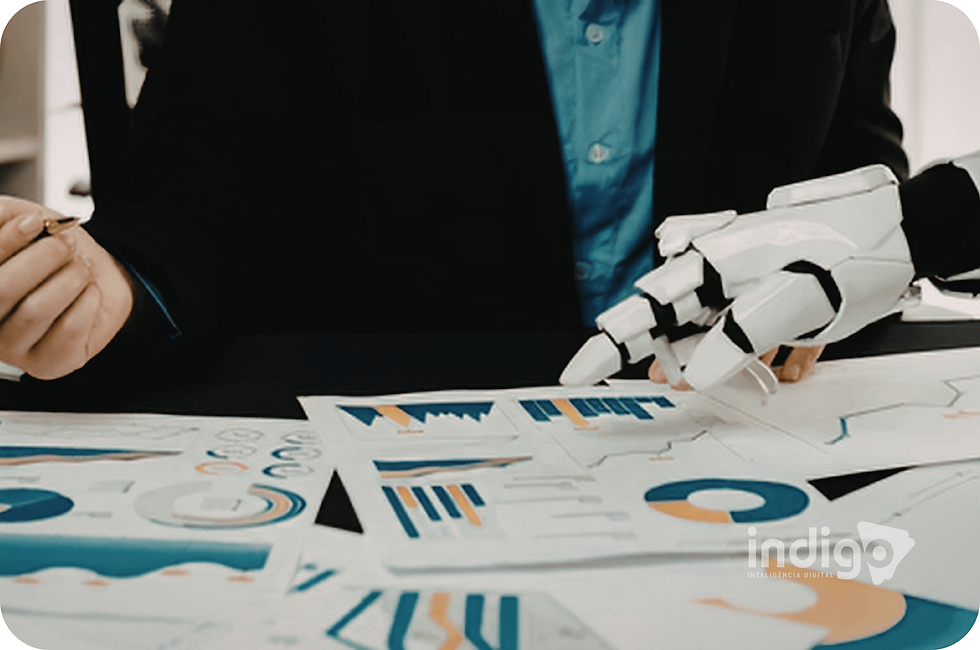
The future of work will be hybrid.
Ideal model:
Human + AI = High performance
AI performs massive analysis.
Humans make strategic decisions.
AI performs repetition.
Humans create innovation.
Conclusion
Artificial intelligence is not the enemy of the professional.
She is:
Capacity amplifier
Reducer of mechanical tasks
Strategic tool
Innovation engine
The question is not:
Will AI replace professionals?
The correct question is:
"Are your company and your team ready to work with AI?"


Comments