
How technology and digital marketing work together to drive business growth

The End of the Separation Between Technology and Marketing
For many years, technology and marketing were seen as completely different areas within companies.
The technology department handled systems, infrastructure, and support.
Marketing was responsible for communication, campaigns, and customer relations.
Today, this separation no longer makes sense.
Consumer behavior has changed.
Communication channels have changed.
Purchasing processes have changed.
And, most importantly, data has come to play a central role in growth strategies.
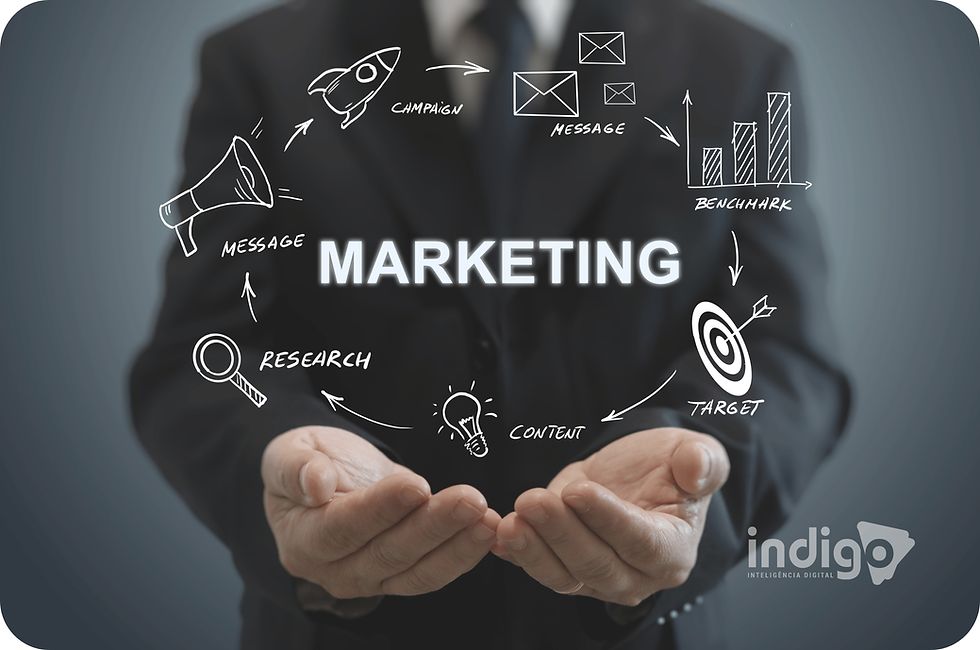
In this new scenario, technology and marketing have become inseparable partners.
The most efficient campaigns depend on data.
Personalization depends on intelligent systems.
Automation depends on technology.
Results analysis depends on digital platforms.
Companies that understand this integration are able to grow faster, more predictably, and more sustainably.
Those that continue to treat technology and marketing as isolated areas tend to lose competitiveness.
The New Consumer is Digital
Before understanding the relationship between technology and marketing, it's important to understand a fundamental change.
The modern consumer is digital.
Regardless of the segment, a large part of the buying journey happens online.
Today, customers:
Research before buying
Compare alternatives
Consult reviews
Consume educational content
Interact with brands digitally
Many decisions are made even before the first commercial contact.
This means that companies need to be prepared to operate strategically in digital environments.
And this preparation depends directly on technology.
Modern Marketing is Driven by Data
For a long time, campaigns were created primarily based on experience and perception.
While these factors remain important, today decisions can be much more precise.
Technology allows us to collect information about:
User behavior
Customer preferences
Traffic sources
Conversion rates
Buyer's journey
This data helps companies better understand their audience.
The greater the understanding, the greater the ability to generate results.
Digital transformation has changed the way we sell.
The traditional sales process used to rely heavily on active prospecting.
Currently, most customers initiate contact already possessing information about the company.
They arrive more prepared.
More informed.
More demanding.
In this context, marketing and technology work together to build an efficient journey.
The goal is not just to attract visitors.
It's to transform visitors into real business opportunities.
The Role of Websites in Generating Growth
Many companies still see their websites as simple digital business cards.
But a modern website can perform much more strategic functions.
It can:
Generate leads
Educate customers
Present solutions
Demonstrate authority
Support sales
Technology plays a fundamental role in this.
Performance, usability, integration, and user experience directly influence the results.
Excellent content loses value when presented in a poor digital experience.

SEO: Technology and Content Working Together
One of the best demonstrations of this integration is SEO (Search Engine Optimization).
SEO depends simultaneously on:
Marketing
Content Production
Keyword Strategy
Communication with the Audience
Technology
Website Speed
Technical Structure
Indexing
User Experience
Security
Success doesn't depend on just one side.
It depends on the combination of both.
Marketing Automation: Scaling Relationships
One of the great contributions of technology to modern marketing is automation.
Specialized tools allow you to automate activities such as:
Sending emails
Lead nurturing
Audience segmentation
Content distribution
Opportunity tracking
This allows companies to maintain continuous relationships with thousands of people simultaneously.
Without technology, this level of scale would be virtually impossible.
CRM: Transforming Contacts into Opportunities
Another important example is the use of CRM (Customer Relationship Management) systems.
These platforms help companies organize information about customers and potential customers.
With a well-structured CRM, it is possible to:
Track interactions
Understand needs
Identify opportunities
Improve the sales process
The integration between marketing and CRM creates a much more complete view of the customer journey.
Personalization: The New Market Expectation
Modern consumers expect relevant experiences.
They don't want to receive generic messages.
They want interactions aligned with their interests.
Technology makes this possible.
Through data analysis, companies can offer:
Personalized content
Specific recommendations
Segmented campaigns
More relevant experiences
Personalization increases engagement and improves results.
Artificial Intelligence is Redefining Marketing
Few technologies are impacting marketing as much as Artificial Intelligence.
Currently, AI can already assist in:
Content Production
Supporting teams in creating materials.
Data Analysis
Identifying patterns invisible to traditional analyses.
Audience Segmentation
Creating more efficient campaigns.
Automated Customer Service
Through intelligent virtual assistants.
Behavior Prediction
Anticipating customer needs.
This integration is expected to intensify in the coming years.
Customer Experience: The True Competitive Advantage
Marketing isn't just about attracting people.
It's about creating experiences.
And experiences increasingly depend on technology.
When a customer interacts with a company, they evaluate aspects such as:
Ease of navigation
Response speed
Quality of service
Simplicity of processes
All these factors influence the perception of value.
Companies that invest in digital experience tend to generate more trust and loyalty.

The Role of Systems Integration
One of the biggest obstacles to growth is information fragmentation.
Marketing uses one tool.
Sales uses another.
Customer service uses a third.
When these systems don't communicate, problems arise such as:
Inconsistent data
Rework
Lack of visibility
Loss of opportunities
Technological integration allows for the creation of a single view of the customer.
This improves operational efficiency and the quality of decisions.
Data-driven marketing leads to better decisions.
One of the greatest advantages of technology is the ability to measure results.
Today it's possible to track indicators such as:
Traffic
Conversions
Engagement
Return on investment
Lead source
This information allows for quick adjustments and more accurate decisions.
Companies stop working with assumptions and start working with evidence.
Small businesses can also benefit from this transformation.
There's a misconception that only large organizations can utilize advanced technology in marketing.
In reality, small and medium-sized enterprises have access to increasingly affordable tools.
The difference lies in the strategy.
Not necessarily in the size of the investment.
Companies that use technology intelligently can compete at levels previously unimaginable.
The future of growth will be increasingly digital.
The coming years will be marked by even greater integration between:
Artificial Intelligence
Automation
Data Analysis
Digital Experience
Personalized Marketing
The most successful companies will be those capable of connecting technology, communication, and relationships into a single strategy.

Technology and marketing are not separate areas.
Perhaps the main conclusion is this:
Modern marketing is technology.
And modern technology needs to consider marketing.
The two areas work together to:
Attract customers
Build relationships
Generate trust
Improve experiences
Drive growth
When this integration happens, the results tend to be much more consistent.
Conclusion
Digital transformation has redefined how companies attract, acquire, and retain customers.
In this new scenario, technology and marketing have ceased to operate independently and have become an integrated ecosystem for growth.
Data, automation, Artificial Intelligence, CRM, SEO, and digital experience are shaping a new generation of business strategies.
Organizations that understand this convergence are able to make smarter decisions, create more relevant experiences, and grow sustainably.
The future of marketing will not only be creative.
It will also be technological.
Indigo ID believes that sustainable growth happens when technology and strategy work together.
Through systems development, platform integration, automation, digital experiences, and customized solutions, we help companies transform data into opportunities and innovation into concrete results.
Because, in today's market, it's not enough to be present in the digital environment. It's necessary to build a technological structure capable of continuously driving growth.


Comments